

ETFBOOK's Spread Monitoring module tests every exchange listing, every day, against the bid-ask spread and quote presence targets you set for it, so capital markets teams can see which listings miss target and take the figures into market maker reviews.
A share class does not have one spread. Each exchange listing has its own order book and its own market makers, and investors trade on various listings. Issuers answer for the quality of every listing, so their capital markets teams need to check each one against its own target.
To visualise this – on 14 October 2026, using the “At touch” order book depth, meaning the best bid and ask for a minimal order size, a popular share class quoted a bid-ask spread of 1.2bp on Xetra, rising to 3.7bp on Wiener Börse. Its Vienna listing also carried a quote for only 74.79% of the session, against 98.63% or more on every other venue shown. Listing-level data like this is spread across separate venues, a problem covered in our analysis of ETF data fragmentation.

Daily Summary, iShares Core S&P 500 UCITS ETF, selected listings on 14 October 2026, 5.0bp illustrative target. Source: ETFBOOK, data as of October 2026.
This is why ETFBOOK built Spread Monitoring. It tracks spreads listing by listing on a watchlist the user configures, compares each listing with its own target every day, and puts listings on different exchanges side by side. The sections below show how targets are set, then apply them to two groups of real ETF listings.
How to set spread and presence targets per listing?
For each listing on a watchlist, you set three values: a target spread in basis points, a spread tolerance, and a target presence, defined as the share of the continuous trading session, sampled every minute, during which a quote is available. Listings are added by name, by Bloomberg ticker, by ISIN, or in bulk through an Excel template.

Example configuration with illustrative targets per listing. Source: ETFBOOK, data as of October 2026.
The Daily Summary marks a spread below target as On Target and one up to target plus tolerance as Within Tolerance. Anything wider is In Breach. Quote presence is tested against its own target in the same view. Spreads default to the “At touch” order book depth and can be recalculated at greater order book depth and in another currency, to match the trade sizes investors execute.
Visual benchmarking of core and options-based ETF listings
We built two watchlists on a single criterion: the three largest European share classes by assets in two categories, S&P 500 and options-based strategies. The targets in both are illustrative values set by ETFBOOK for this article, not commitments agreed by any issuer or market maker.
On 14 October 2026, at the “At touch” depth, all three listings on the London Stock Exchange met or came close to their targets. The iShares Core S&P 500 UCITS ETF quoted 1.3bp against a 2.0bp target, On Target. The Vanguard S&P 500 UCITS ETF quoted 2.1bp against a 2.0bp target and the Invesco S&P 500 UCITS ETF 3.1bp against a 3.0bp target, both Within Tolerance.

Daily Summary, three largest S&P 500 share classes in Europe on the London Stock Exchange, illustrative targets, “At touch”. Source: ETFBOOK, data as of October 2026.
The options-based watchlist holds JPM Nasdaq Equity Premium Income (JEPQ), JPM Global Equity Premium Income (JEPG) and Global X Nasdaq 100 Covered Call (QYLD), all UCITS ETFs listed on the London Stock Exchange, each with an illustrative 10.0bp target and a 1.0bp tolerance. On the same day, JEPQ quoted 5.3bp and was On Target, JEPG quoted 10.5bp and was Within Tolerance, and QYLD quoted 14.1bp, 41.2% above target and In Breach. All three were quoted for at least 99.80% of the session, QYLD for 100.00%: the reverse of the Vienna case, and the reason presence and spread are reported separately. The next section tests the same day’s spreads against a stricter 5.0bp target.

Daily Summary, three largest options-based share classes in Europe, illustrative 10.0bp target. Source: ETFBOOK, data as of October 2026.
Tailoring targets to each institution's own standards
A spread target is each ETF issuer’s own decision rather than a market constant. An issuer may hold an options-based range to the same standard as its core products or accept wider spreads for strategies with a more complex hedge. At a more rigorous target of 5.0bp with the same tolerance, the same day’s spreads give a different result: JEPQ moves to Within Tolerance, while JEPG and QYLD are both In Breach.
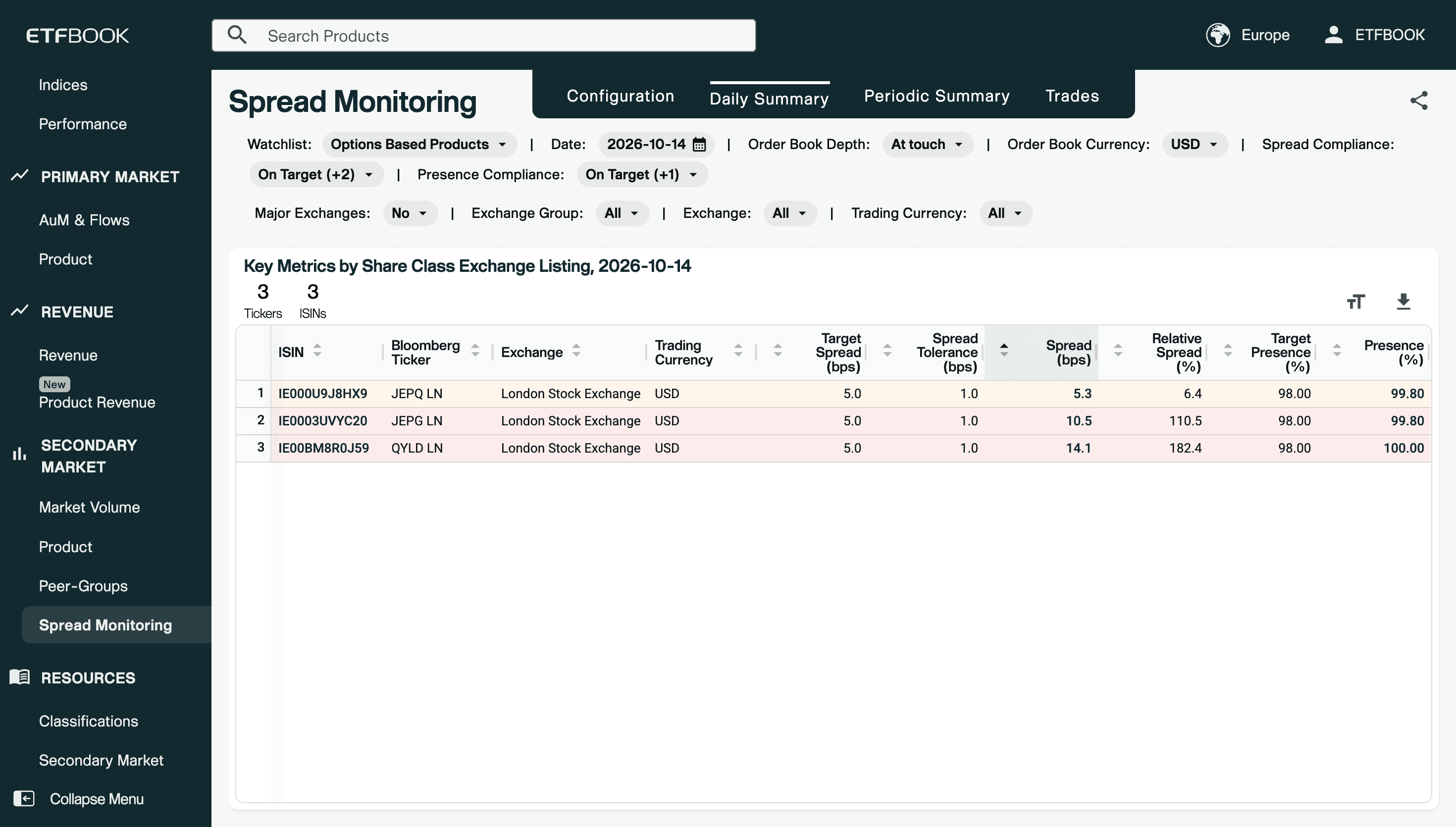
The same listings and day against a stricter 5.0bps illustrative target. Source: ETFBOOK, data as of October 2026.
The spreads are identical in both views; only the benchmarking standards change. Each target can follow the institution's own policy, whether that is a liquidity provider agreement, an exchange obligation or an internal benchmark.
Monitoring spreads from a daily result to a market maker review
One day may be a weak signal on the overall market tendencies. The Periodic Summary reports average, minimum and maximum daily spread per listing over a chosen window. In September 2026, the Invesco S&P 500 listing averaged 3.2bp against its 3.0bp target, Within Tolerance, but its widest day reached 4.1bp, In Breach.

Periodic Summary, three largest S&P 500 share classes in Europe on the London Stock Exchange, illustrative target in September 2026. Source: ETFBOOK, data as of October 2026.
Finally, the Trades tab places these results next to trading activity for each listing, including shares traded, number of trades and volume.
Try Spread Monitoring in ETFBOOK
For a capital markets desk, Spread Monitoring changes the order of work. Each day starts from the listings In Breach rather than from manually reconciling spreads against the targets agreed with market makers, and each market maker review starts from monthly figures for the listings that market maker covers.
Spread Monitoring is one of the Secondary Market modules available in the ETFBOOK 2.0 web platform. Explore Spread Monitoring in the platform now, or if you do not have access to ETFBOOK yet, request a free trial.

